THERMAL ATLAS

A field guide · 162 audited sources · 2026

碳中和数据中心
热管理图志
A thermal atlas of carbon-neutral data centers

从黑箱学习到物理知情控制。这不是又一份算法清单,而是一套可部署的判断框架:控制器知道什么物理、会在哪一层失败、碳中和的价值又在哪一层被创造。 From black-box learning to physics-informed control. Not another algorithm catalogue, but a deployment architecture: what physics the controller knows, where it fails, and where carbon-neutral value can actually be created.

综述底本Source reviewTRCN-2026-0008
作者AuthorsFei Li · Hong Liu · Hailiang Luo · Yuqi Shi
组织透镜Organizing lens 物理知情深度,而非算法标签 Physics-awareness depth, not algorithm labels
Scroll

00 — Prolegomenon

如何使用这本地图 How to use this atlas

本站是一篇面向研究生、设施工程师与政策研究者的双语深度教程,改写自 Li、Liu、Luo 与 Shi 的综述。图版来自原文;叙述按教学逻辑重排,并严格区分仿真、台架与现场证据。 A bilingual graduate tutorial rewritten from the review by Li, Liu, Luo and Shi. The plates are from the manuscript; the narrative is reordered for teaching, and simulation, testbed, and field evidence are kept strictly apart.

01 · READERS

三种读者,三条路径 Three readers, three paths

做控制的人从第 3–4、7 章读起;做制冷与液冷的人从第 2、8 章读起;关心碳与电网的人从第 1、6、9 章读起。第 10 章是共同出口。 Controllers start at chapters 3–4 and 7. Cooling engineers start at 2 and 8. Carbon and grid readers start at 1, 6 and 9. Chapter 10 is the shared exit.

02 · HONESTY

不把仿真写成投产 Simulation is not production

162 篇是“来源”而不是“实验”。IEA 展望与 ASHRAE 热环境指南是仅有的两份权威例外。百分比节能量因气候、负载、边界与会计口径不可加总,本教程拒绝伪元平均。 The 162 items are sources, not experiments. The IEA outlook and the ASHRAE thermal guideline are the only two authoritative exceptions. Percentage savings are not pooled across climates, loads, boundaries, or accounting conventions.

03 · KEY

三个贯穿问题 Three recurring questions

对每一种方法只问三件事:什么物理知识进入了决策系统?它试图拆掉哪一块部署壁垒?现有证据最高只到仿真、台架,还是现场? Ask only three things of every method: what physical knowledge enters the decision system; which deployment barrier it claims to remove; and whether the strongest evidence is simulation, testbed, or field.

01 — The problem

两个耦合的难题 Two coupled problems

热管理不是旁路负荷。它是算力需求、设备可靠性、地方水资源与电网碳强度之间的物理界面。 Thermal management is not an auxiliary load. It is the physical interface among computing demand, equipment reliability, local water, and the time-varying carbon intensity of electricity.

415
TWh · 2024
IEA 报告的全球数据中心用电,约合全球电力的 1.5%。 IEA reported global data-center electricity, about 1.5% of world demand.
945
TWh · 2030 base
基准情形下接近全球电力的 3%。加速计算是主要驱动。 Just under 3% of global demand in the base case. Accelerated computing is a principal driver.
7–30%+
cooling share
高效超大规模约 7%,低效企业级可超过 30%。冷却占比本身就是效率地图。 About 7% in efficient hyperscale halls, more than 30% in less-efficient enterprise sites.
μs → d
timescale span
计算脉冲以微秒计,冷源调度以小时到日计。控制器若无视滞后,会在稳态基准里显得很聪明。 Compute pulses in microseconds; plant dispatch in hours to days. A controller that ignores lag looks clever on a stationary benchmark.

数据中心用电的已发表估计在方法上并不一致。冷却占比、自下而上重标定、美国服务需求脱钩、系统动力学预测、水–碳清单与空调能耗综述,共同框出剩余不确定性。把其中任何一个数字单独写成“全球真相”,都是对文献的误读。 Published estimates of data-center electricity remain methodologically heterogeneous. Cooling-share surveys, earlier bottom-up recalibrations, US service-demand decoupling, system-dynamic forecasts, water–carbon inventories and air-conditioning reviews bound the residual uncertainty. Treating any single number as the global truth is a misreading of the literature.

第一难题:热力–计算的时间尺度错位 First problem: a thermodynamic–computing timescale mismatch

处理器功率可在微秒到毫秒内跳变;气流控制以秒响应,液体回路以数十秒,冷冻水以分钟,园区调度则以小时或日。结果是一个非线性、有滞后、空间耦合的系统。快产热与慢排热制造热点、保守温度裕度和慢性过冷。 Processor power can change in microseconds to milliseconds. Airflow responds in seconds, liquid loops in tens of seconds, chilled water in minutes, and campus dispatch over hours or days. The result is nonlinear, delayed, and spatially coupled. Fast heat generation and slow rejection create hot spots, conservative temperature margins, and chronic overcooling.

第二难题:可持续性联结 Second problem: a sustainability nexus

PUE(电能使用效率)对机房运行仍然有用,但不能判定一项热策略是否兼容碳中和。蒸发冷却可以省电却增加直接用水;跨地理迁移负载可以降低平均碳强度却增加时延或网络能耗;液冷可以减少风机功率,同时改写泵功、冷却剂材料、余热品位与隐含影响。 Power usage effectiveness remains useful for plant operations, but it cannot decide whether a thermal strategy is compatible with carbon neutrality. Evaporative cooling can cut electricity while raising direct water use. Geographic migration can lower average carbon intensity while adding latency or network energy. Liquid cooling can cut fan power while rewriting pump work, coolant materials, waste-heat quality, and embodied impacts.

能量、水、碳、可靠性与服务质量是相互作用的目标,不能塌缩成一个效率分数。 Energy, water, carbon, reliability and service quality are interacting objectives. They cannot be collapsed into one efficiency score.
min J(π) = [ E(π), W(π), C(π), R(π), −Q(π) ]
式 (1)。π 为控制策略;负号把服务质量最大化写成与其余目标相同的最小化形式。权值不固定,因为可接受的权衡随运行与政策条件改变。 Equation (1). π is the policy. The minus sign writes service-quality maximisation in the common minimisation form. Weights are not fixed, because the acceptable trade-off changes with operating and policy conditions.
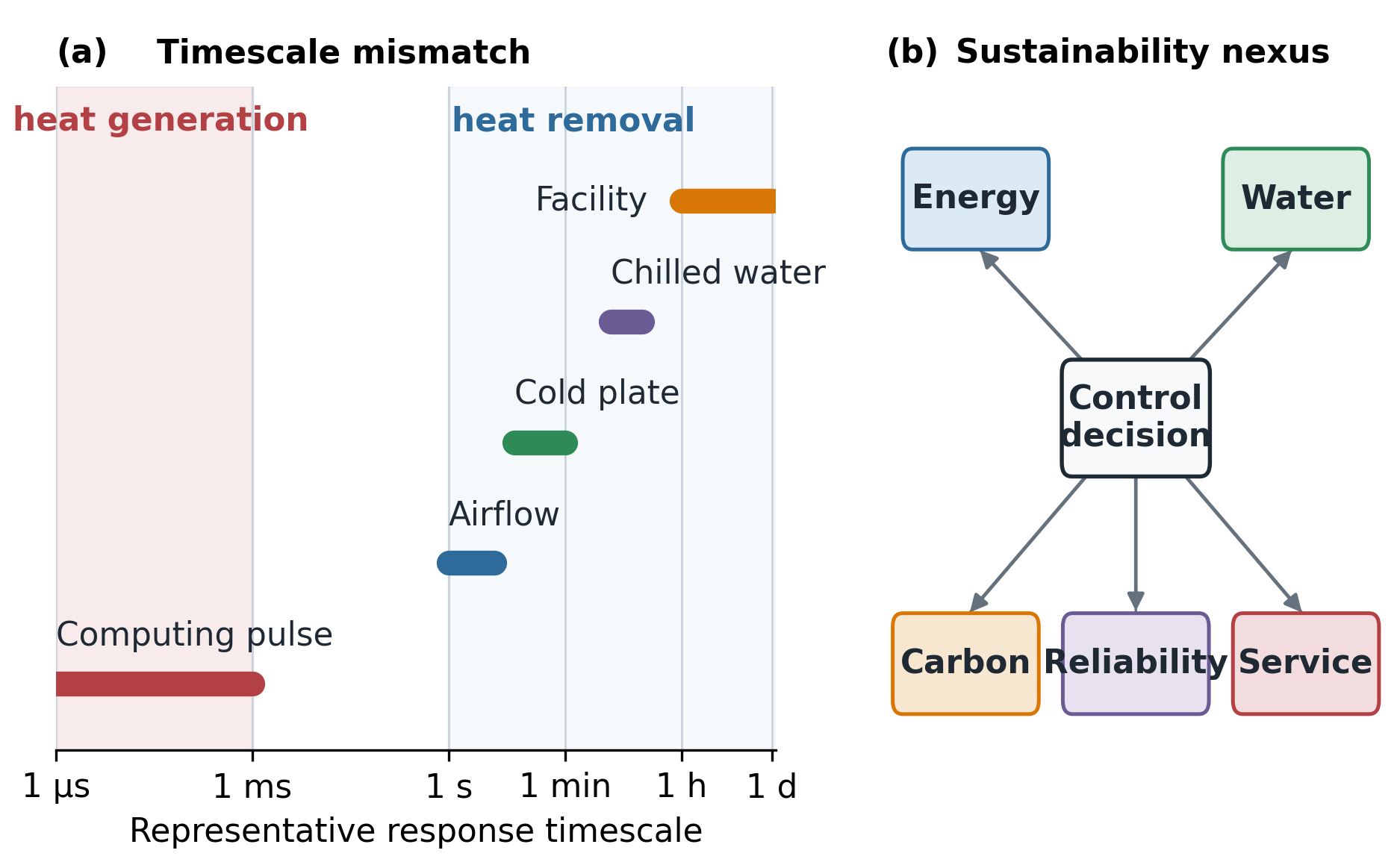
Figure 1. Timescale mismatch and sustainability nexus.
Plate I
数据中心热管理问题的平行框架。(a) 代表性响应时间显示计算产热与排热基础设施的尺度错位;范围为概念量级,不是某一机房的实测。(b) 每一次热控制决策都耦合能量、水、碳、可靠性与服务。箭头表示双向依赖。 Parallel framing of the thermal-management problem. (a) Representative response times show the mismatch between computing heat generation and heat-removal plant; ranges are conceptual orders of magnitude, not measurements from one hall. (b) Every thermal-control decision couples energy, water, carbon, reliability and service. Arrows mark two-way dependence.

02 — Hardware as envelope

物理包络,而不是设备目录 The physical envelope, not a hardware catalogue

冷却硬件定义可行控制集合,但不是这篇综述的组织原则。只在它改写可控性、传感、安全或生命周期时,硬件才进入叙述。 Cooling hardware defines the feasible control set, but it is not the organizing principle. Hardware enters the story only where it rewrites controllability, sensing, safety, or lifecycle outcomes.

AIR

风冷 Air cooling

执行器成熟、成本低、运维熟悉。高机柜密度下受回流与风机功率约束。PID 与送风温度设定在这一层仍然是可靠的回退。 Mature actuation, low cost, familiar operations. Constrained by recirculation and fan power at high rack density. PID and supply-air set-points remain a trustworthy fallback at this layer.

D2C

芯片液冷 Direct-to-chip

减轻空气侧负担,并可能提高余热温度。同时引入泵、冷板、泄漏检测与负载放置的新耦合。Heydari 等在 Appl. Therm. Eng. 上的实验给出了可核对的硬件证据,而不是宣传口径。 Reduces the air-side burden and can raise waste-heat temperature. It also introduces pumps, cold plates, leak detection, and placement coupling. Heydari and colleagues provide checkable hardware evidence in Applied Thermal Engineering, not a brochure claim.

IMMERSION

浸没与两相 Immersion and two-phase

同时改写传热动力学与维护约束。Kanbur 等的浸没研究、Wu 等对冷板的综述,应被读成控制可行域的变化,而不是“下一代一定更好”。 They rewrite both heat-transfer dynamics and maintenance constraints. Immersion studies and cold-plate reviews should be read as changes to the feasible control set, not as a promise that the next generation is automatically better.

已有综述分别覆盖冷却系统、热感知调度、启发式优化、强化学习以及可迁移的建筑控制方法。建筑暖通文献在本图志中只作为标明的迁移证据出现:方法可以借用,场景不能偷换。把一座办公楼的 MPC 写成数据中心现场,是本教程明确拒绝的写法。 Existing surveys separately cover cooling systems, thermal-aware scheduling, heuristic optimisation, reinforcement learning, and transferable building-control methods. Building HVAC enters this atlas only as labelled transfer evidence: methods may be borrowed, settings may not be swapped. Writing an office-building MPC as a data-center field result is a form this tutorial refuses.

03 — Taxonomy

用物理知情深度组织文献 Organise the field by physics-awareness depth

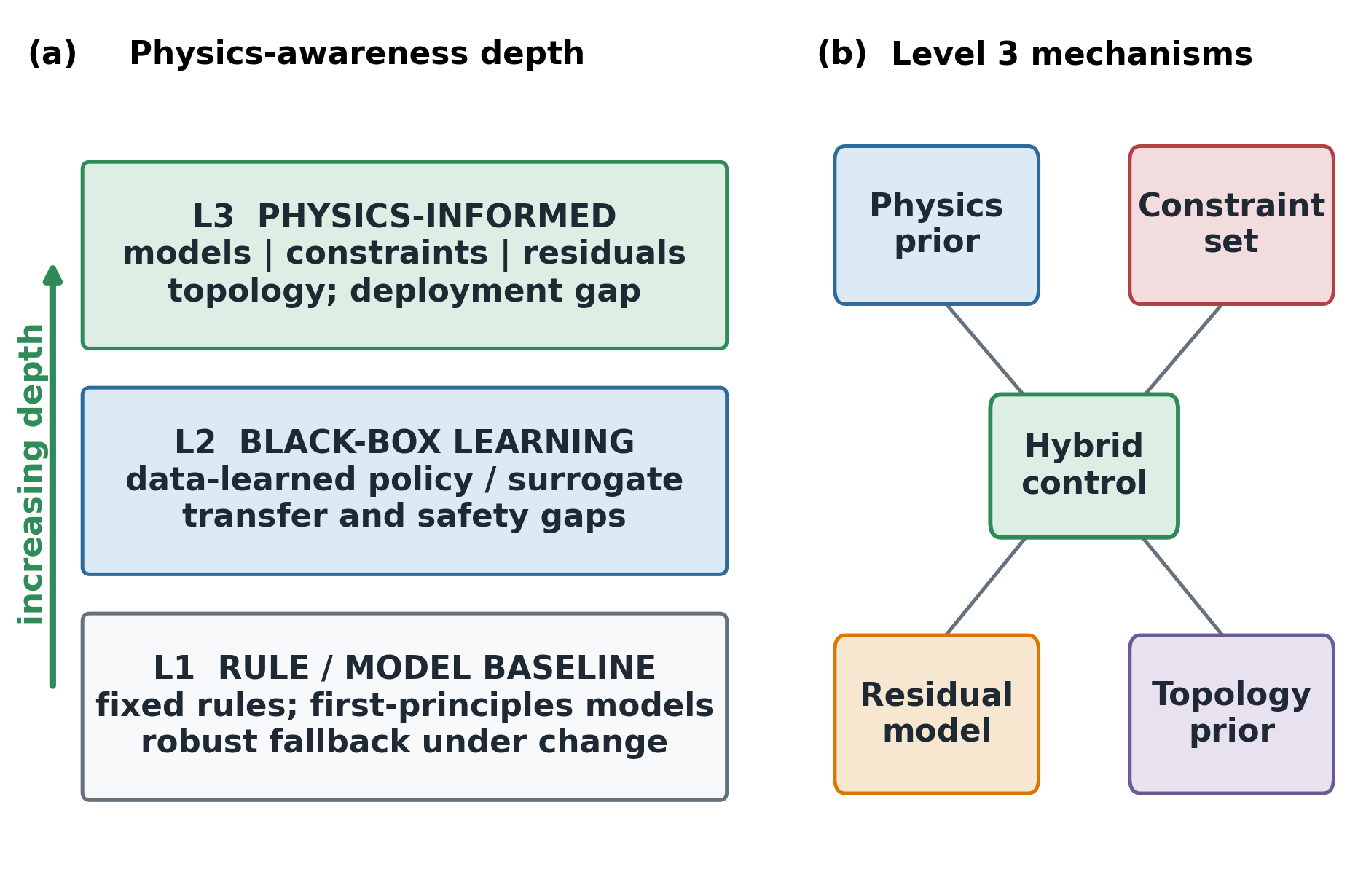
同一算法家族可以落在不同层级,取决于它嵌入了什么信息、如何设防。层级描述的是实现,不是不可更改的标签。 The same algorithm family can sit at more than one level, depending on what it embeds and how it is safeguarded. The levels describe implementations, not immutable labels.

L1 · BASELINE

规则 / 机理模型 Rules and first-principles models

固定规则与运行不变量。最佳角色是快速局部控制与故障回退。主要壁垒是适应能力有限。最低可信证据:已投运包络与失效保护测试。 Fixed rules and operating invariants. Best role: fast local control and fallback. Principal barrier: limited adaptation. Minimum credible evidence: a commissioned envelope and fail-safe tests.

L2 · BLACK BOX

黑箱学习 Black-box learning

从数据学习策略或代理模型。在训练支撑内可以适应,但迁移与安全是结构性缺口。最低可信证据:留出扰动与约束违反报告,而不是只报平均奖励。 A policy or surrogate learned primarily from data. It can adapt inside its trained support; transfer and safety are structural gaps. Minimum credible evidence: held-out disturbances and constraint-violation reports, not mean reward alone.

L3 · PHYSICS-INFORMED

物理知情混合 Physics-informed hybrids

先验、约束、残差或拓扑进入学习或决策。目标是有界适应。新的风险是物理误设与不确定性。最低可信证据:带回退统计的台架或现场。 Priors, constraints, residuals or topology enter learning or decisions. The aim is bounded adaptation. New risks are misspecified physics and uncertainty. Minimum credible evidence: testbed or field results with fallback statistics.

第三层的四种机制 Four mechanisms at Level 3

物理先验把守恒或传热结构写进模型;约束集把动作限制在热不变量之内;残差模型让机理部分承担已知动力学、让学习修正未知偏差;拓扑先验把机柜、气流或管路的连接关系变成归纳偏置。它们通向同一种工程对象:混合控制,而不是一个新的会议关键词。 A physics prior writes conservation or heat-transfer structure into the model. A constraint set keeps actions inside thermal invariants. A residual model lets first principles carry known dynamics while learning corrects unknown bias. A topology prior turns rack, airflow or piping connectivity into inductive bias. All four lead to the same engineering object: hybrid control, not a new conference keyword.

Figure 2. Physics-awareness taxonomy.
Plate II
物理知情深度。(a) 从规则基线到黑箱学习再到物理知情集成。(b) 第三层通过先验、约束、残差与拓扑四种机制汇入混合控制。部署缺口主要出现在这一层:知道物理,不等于已经在现场安全运行。 Physics-awareness depth. (a) From rule baselines through black-box learning to physics-informed integration. (b) Level 3 joins hybrid control through priors, constraints, residuals and topology. The deployment gap lives mainly here: knowing the physics is not the same as running safely in the field.

04 — Genealogy

算法谱系:谁继承了谁的问题 Algorithm genealogy: who inherits whose problems

不必把 PID、进化搜索、MPC 与强化学习排成一张虚假的性能榜。它们的角色可以组合:离线搜设计,代理降成本,预测控制守慢约束,保守学习从运行数据适应。 PID, evolutionary search, MPC and reinforcement learning need not be ranked on one artificial leaderboard. Their roles compose: search designs offline, cheapen models with surrogates, let predictive control hold slow constraints, and let conservative learning adapt from operations.

OPTIMISATION & CONTROL

从遗传算法到经济 MPC From genetic search to economic MPC

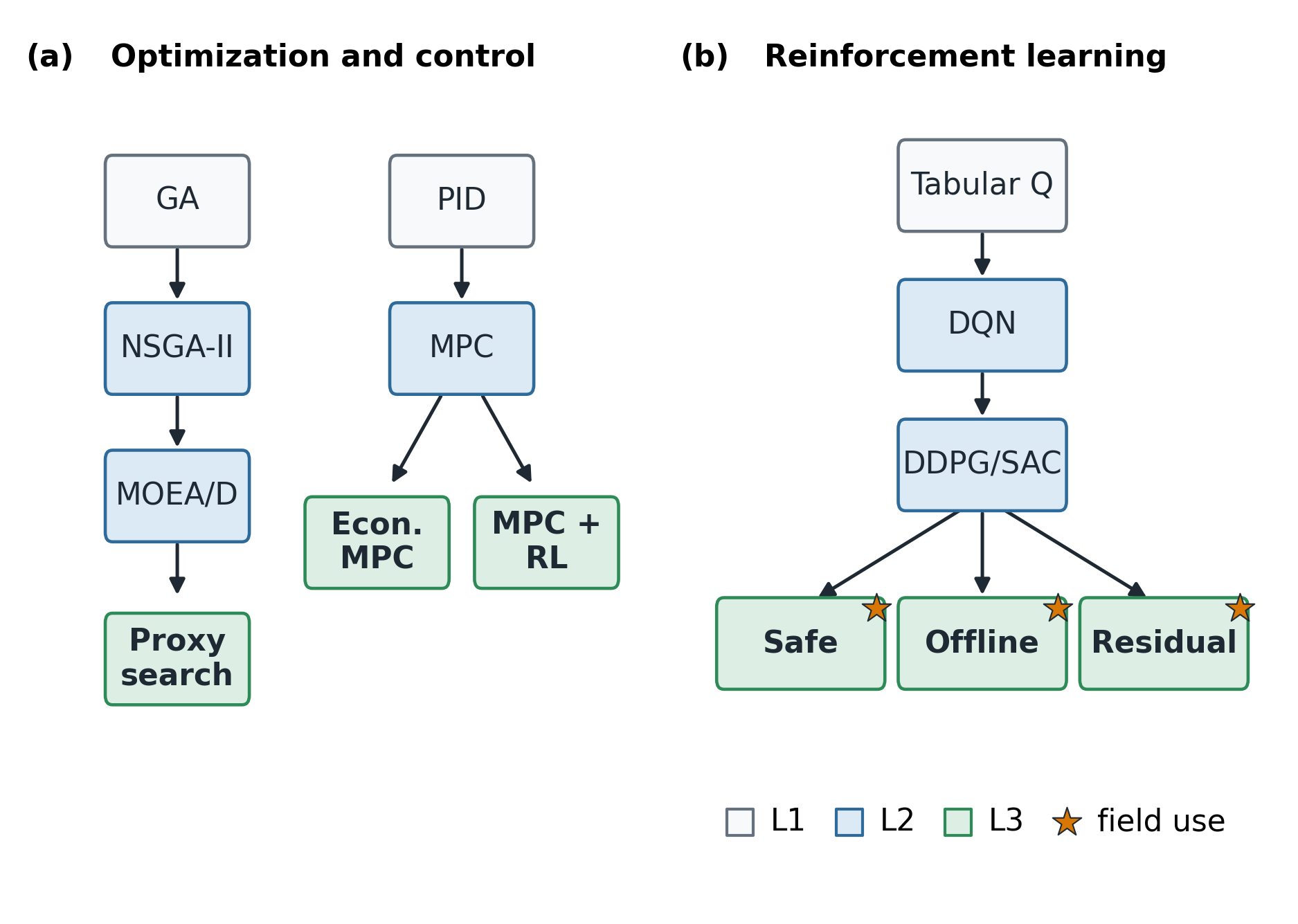
GA → NSGA-II → MOEA/D → 代理搜索,是一条离线帕累托设计链。PID → MPC → 经济 MPC / MPC+RL,是一条在线监督链。进化方法的壁垒是在线代价与迁移;MPC 的壁垒是标定与在线计算。 GA → NSGA-II → MOEA/D → proxy search is an offline Pareto-design chain. PID → MPC → economic MPC / MPC+RL is an online supervisory chain. Evolutionary methods stall on online cost and transfer; MPC stalls on calibration and online compute.

REINFORCEMENT LEARNING

从表格 Q 到安全 / 离线 / 残差 From tabular Q to safe, offline, residual

表格 Q → DQN → DDPG/SAC,是表达能力的扩张。真正改变部署前景的,是安全 RL、离线 RL 与残差 RL。图中星号标出现场使用:那是稀缺证据,不是默认状态。 Tabular Q → DQN → DDPG/SAC expands expressivity. What changes deployment prospects is safe, offline and residual RL. Stars on the plate mark field use: scarce evidence, not the default state of the literature.

读图口诀 How to read the plate

浅色是 L1,蓝色是 L2,绿色是 L3。颜色比算法名字更重要:一个带硬约束的 DQN,在本图志里比一个无约束的“物理知情”口号更接近第三层。 Pale is L1, blue is L2, green is L3. Colour matters more than the algorithm name: a DQN with hard constraints sits closer to Level 3 than an unconstrained method that merely claims to be physics-informed.

Figure 3. Algorithm genealogy.
Plate III
算法谱系。(a) 优化与控制;(b) 强化学习。颜色表示物理知情深度,星号表示现场使用。谱系的意义是继承关系:后一代往往继承前一代未解决的迁移与安全问题。 Algorithm genealogy. (a) Optimisation and control; (b) reinforcement learning. Colour marks physics-awareness depth; stars mark field use. Genealogy means inheritance: later methods often inherit the transfer and safety problems of earlier ones.

05 — Landscape

文献地貌:162 篇如何铺开 The literature as a landscape of 162 sources

语料按结构化的批判性证据图报告,而不是 PRISMA 系统综述。缺同期多库检索日志,就必须诚实地这样说。 The corpus is reported as a structured critical evidence map, not a PRISMA systematic review. A contemporaneous multi-database search log was not available, and the tutorial says so.

对投稿书目的审计曾标出直接匹配、未决或不准确、以及需要人工分类的标准/报告/预印本。随后的出版商页面核对纠正了替换集中的作者、卷期与 DOI 错配。最终语料保持 162 条:160 篇同行评审期刊或存档会议论文,外加 IEA 与 ASHRAE 两份权威例外。 An audit of the submitted bibliography identified direct matches, unresolved or inaccurate records, and items that needed manual classification as standards, reports or preprints. Publisher-page checks then corrected author, volume and DOI mismatches in the replacement set. The final corpus remains 162 unique sources: 160 peer-reviewed journal or archival conference papers, plus the IEA and ASHRAE exceptions.

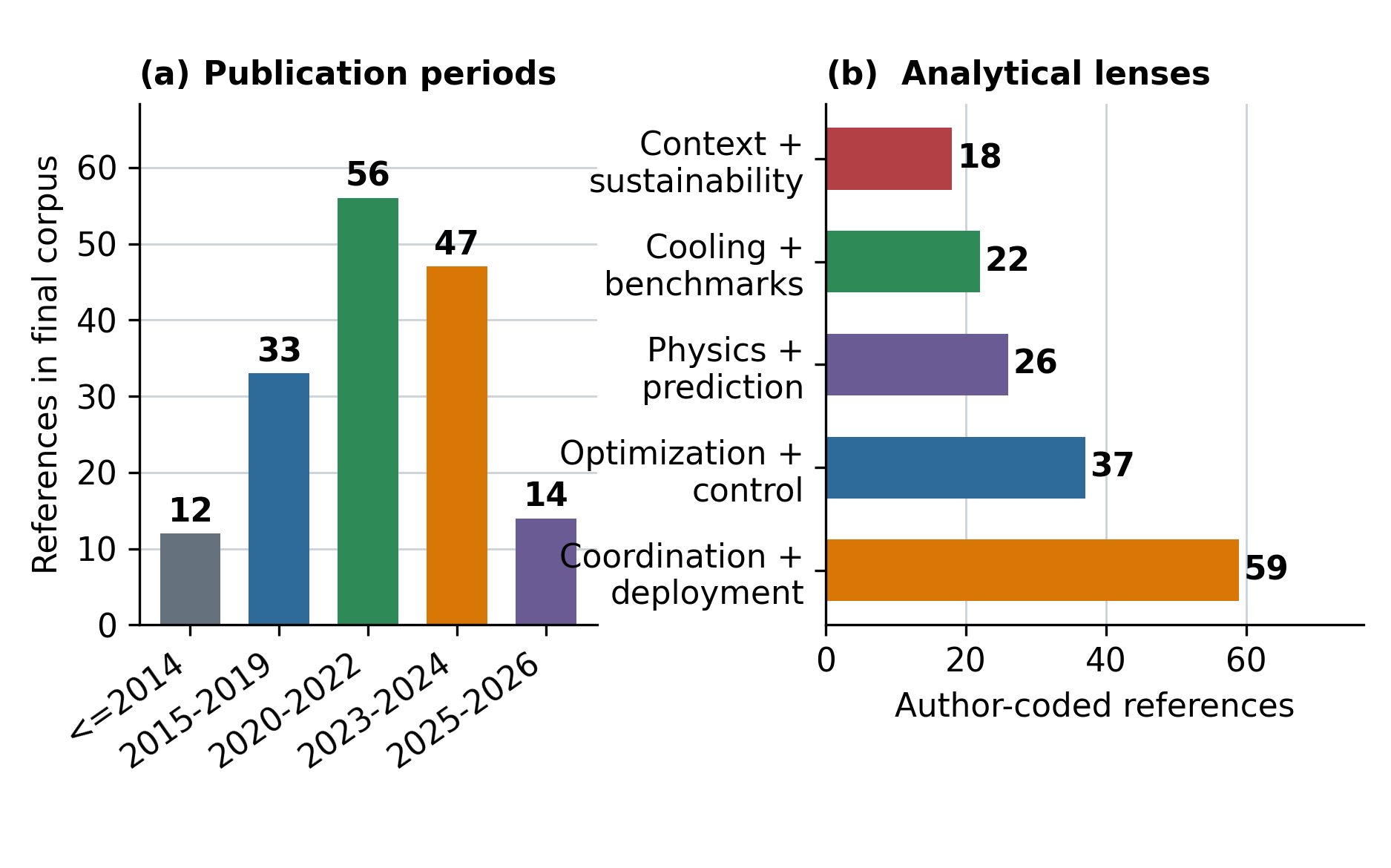
12
≤ 2014
奠基层:机理、标准与早期控制。Foundations: physics, standards, early control.
33
2015–2019
学习进入机房叙事。Learning enters the plant narrative.
56
2020–2022
峰值年份,也是口号最多的年份。Peak years — and the noisiest slogans.
61
2023–2026
47 + 14。现场与液冷开始被认真追问。47 + 14. Field evidence and liquid cooling start to be asked for seriously.

按分析透镜计:情境与可持续性 18,冷却与基准 22,物理与预测 26,优化与控制 37,协同与部署 59。最大的一格不是模型,而是“如何让模型和其他层一起工作”。这本身就是一个诊断:领域并不缺新网络,缺的是可核对的协同与投产。 By analytical lens: context and sustainability 18, cooling and benchmarks 22, physics and prediction 26, optimisation and control 37, coordination and deployment 59. The largest cell is not models, but how models work with other layers. That is itself a diagnosis: the field is not short of new networks; it is short of checkable coordination and deployment.

Figure 4. Literature landscape.
Plate IV
最终语料的出版时段与分析透镜。条形是作者编码计数,不是数据库自动聚类。2025–2026 的 14 篇不是领域萎缩,而是截稿日前可核验文献的自然边界。 Publication periods and analytical lenses in the final corpus. Bars are author-coded counts, not an automatic database cluster. The 14 items in 2025–2026 are a cut-off boundary for verifiable records, not a collapse of the field.

06 — Coordination

跨层协同:价值在层与层之间 Cross-layer coordination: value lives between layers

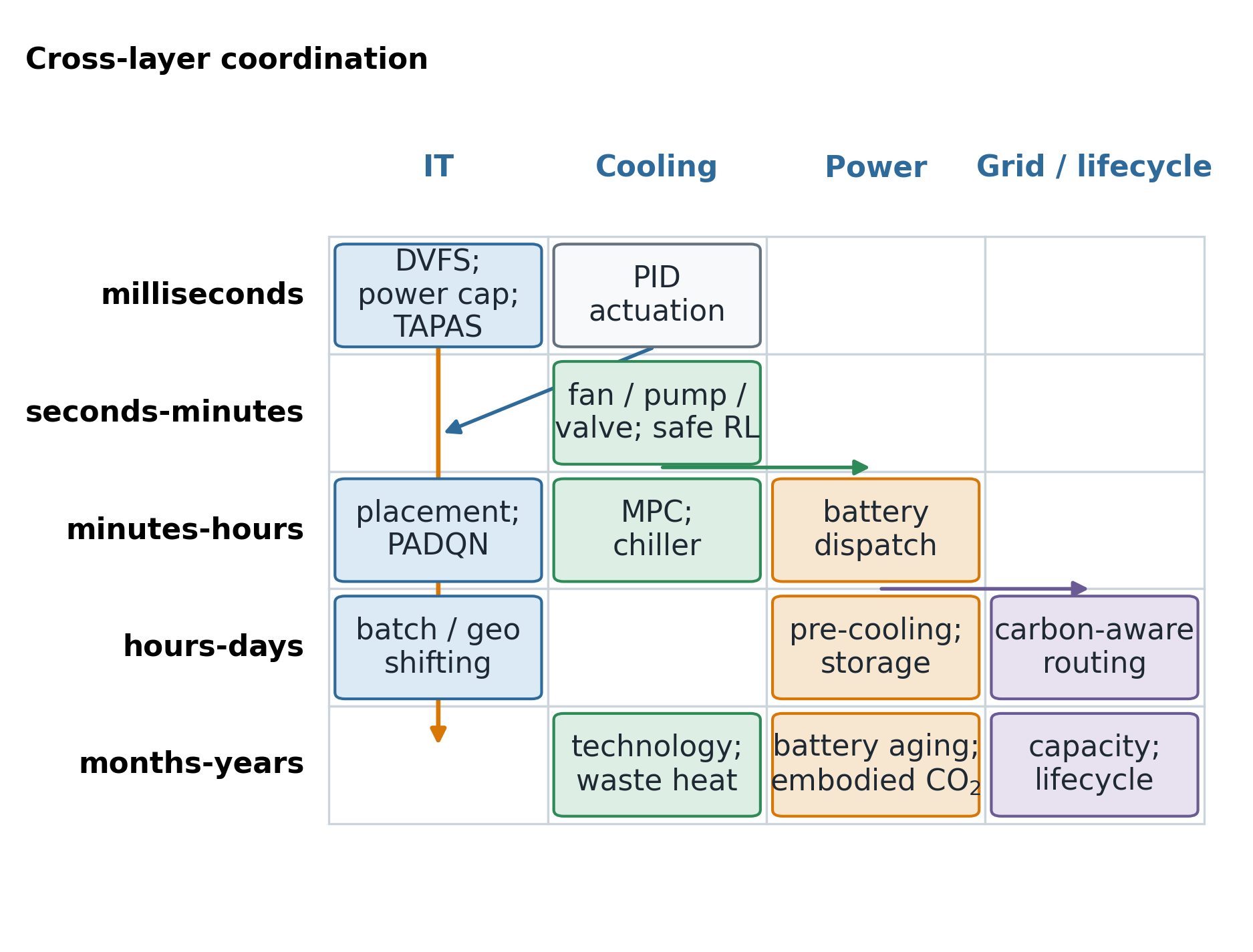
IT、冷却、电力、电网与生命周期在不同时钟上运行。碳中和很少来自把某一层的目标函数再削尖一分,而来自层与层之间的合法交换。 IT, cooling, power, the grid and the lifecycle run on different clocks. Carbon-neutral value rarely comes from sharpening one layer’s objective by another percent. It comes from legitimate exchange between layers.

IT 冷却Cooling 电力Power 电网 / 生命周期Grid / lifecycle
ms DVFS · power cap · TAPAS PID actuation
s–min 风机 / 泵 / 阀 · 安全 RL Fan / pump / valve · safe RL
min–h 放置 · PADQN Placement · PADQN MPC · chiller 电池调度 Battery dispatch
h–d 批处理 / 地理转移 Batch / geo-shifting 预冷 · 储能 Pre-cooling · storage 碳感知路由 Carbon-aware routing
月–年mo–yr 技术路线 · 余热 Technology · waste heat 电池老化 · 隐含碳 Battery ageing · embodied CO₂ 容量 · 生命周期 Capacity · lifecycle

箭头比格子更重要。IT 的功率封顶必须能被冷却回路看见,否则只是把热点从芯片赶到气流。冷却侧的安全 RL 若不能把约束交给电力调度,电池就会在错误的小时放电。地理转移如果不算网络能耗与服务等级,碳账会看起来很好看,可靠性账会很难看。 The arrows matter more than the cells. An IT power cap that cooling cannot see only moves the hot spot from the chip into the aisle. Safe RL on the cooling side that cannot hand constraints to power dispatch will discharge batteries in the wrong hour. Geographic shifting that ignores network energy and service class can make the carbon ledger look better while the reliability ledger looks worse.

Figure 5. Cross-layer coordination.
Plate V
跨层协同矩阵。行是时间尺度,列是 IT、冷却、电力与电网/生命周期。有内容的格子是已有方法的栖息地;空格子是研究空白,也是最容易被口号填满的地方。 The coordination matrix. Rows are timescales; columns are IT, cooling, power and grid/lifecycle. Occupied cells are habitats of existing methods. Empty cells are research blanks — and the places most easily filled with slogans.

07 — Deployment

从论文到机房的六项条件 Six conditions from paper to plant

部署就绪取决于样本效率、可迁移性、显式约束、不确定性监测、回退控制,以及透明的多目标权衡。缺任何一项,现场声明都应降级。 Deployment readiness depends on sample efficiency, transferability, explicit constraints, uncertainty monitoring, fallback control, and transparent multi-objective trade-offs. Missing any one of them should downgrade a field claim.

TRANSFER

三条迁移通路 Three transfer pathways

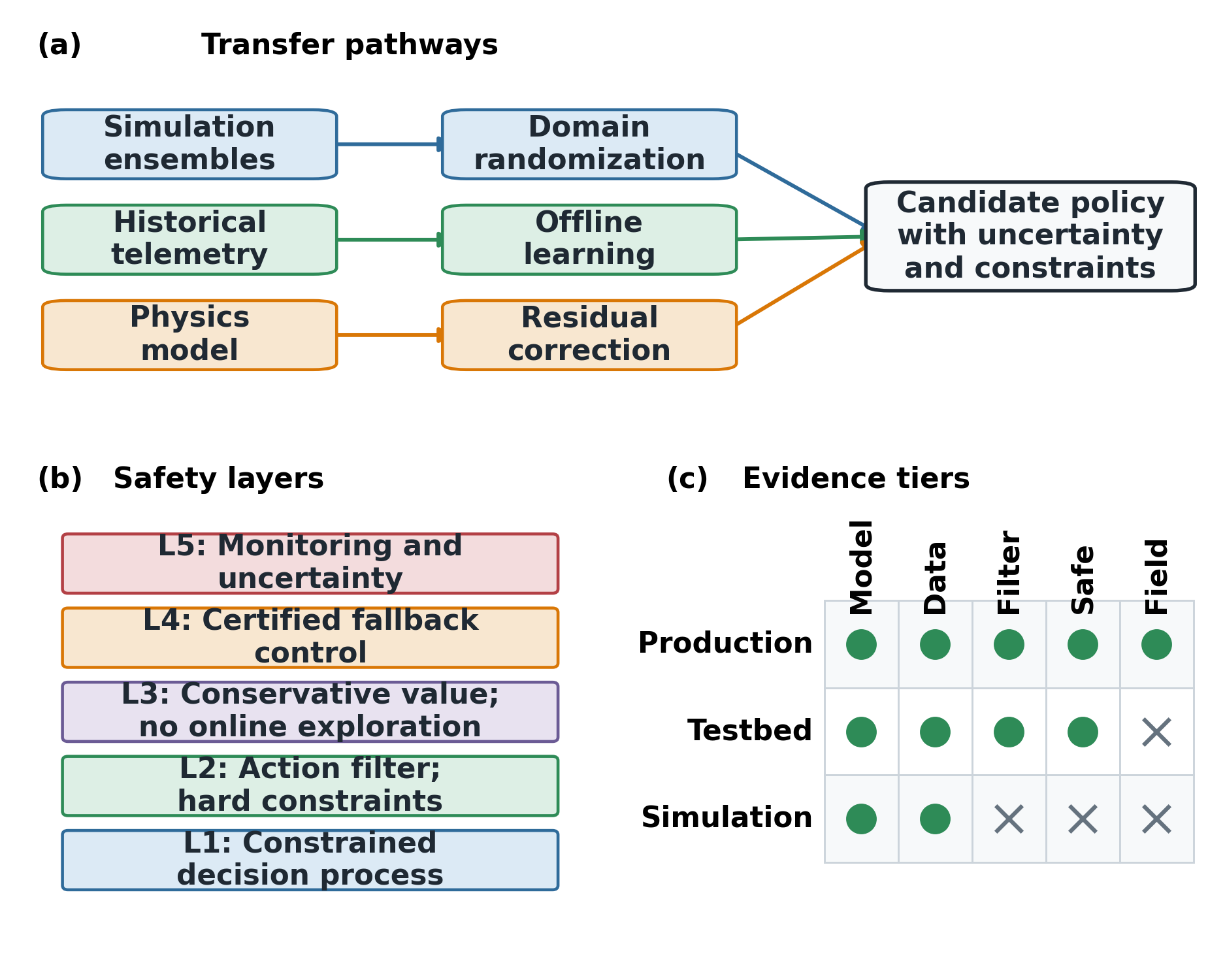
仿真集成 + 域随机化;历史遥测 + 离线学习;机理模型 + 残差修正。它们应汇入带不确定性与约束的候选策略,而不是直接写进 PLC。 Simulation ensembles with domain randomisation; historical telemetry with offline learning; physics models with residual correction. They should feed a candidate policy that already carries uncertainty and constraints — not a PLC register.

SAFETY L1–L5

五层安全,而不是一个奖励塑形 Five safety layers, not one shaped reward

约束决策过程 → 动作过滤与硬约束 → 保守价值、禁止在线探索 → 经认证的回退控制 → 监测与不确定性。奖励塑形不能代替其中任何一层。 A constrained decision process; an action filter with hard constraints; conservative values and no online exploration; certified fallback; monitoring and uncertainty. Reward shaping replaces none of these layers.

EVIDENCE

证据阶梯 Evidence tiers

仿真可以有模型与数据。台架还要有过滤器与安全层。生产则必须加上现场。缺现场的绿色圆点,就不该出现“已在商业机房部署”的句子。 Simulation may have a model and data. A testbed must also have a filter and a safety layer. Production must add the field. Without that last green dot, a sentence about commercial deployment should not appear.

现场与台架必须分开引用。Google 一类的生产控制系统、以及少数可核对的园区级 MPC / 多智能体试验,才构成生产层。房间级台架、数字孪生原型、冷板实验与基准环境是另一类证据:它们证明机制,不证明规模。 Field and testbed citations must be kept apart. Production-layer evidence is a small set: a handful of facility-scale control systems and checkable campus MPC or multi-agent trials. Room-scale beds, digital-twin prototypes, cold-plate experiments and benchmark environments are another class: they prove mechanism, not scale.

Figure 6. Production deployment pipeline.
Plate VI
投产管道。(a) 三条迁移通路汇入带约束的候选策略;(b) 五层安全;(c) 仿真 / 台架 / 生产的证据阶梯。叉号不是侮辱,而是诚实:大多数论文停在仿真格。 The deployment pipeline. (a) Three transfer paths into a constrained candidate policy; (b) five safety layers; (c) evidence tiers for simulation, testbed and production. A cross is not an insult. It is honesty: most papers stop in the simulation row.

08 — Liquid

把液冷写成控制问题 Write liquid cooling as a control problem

液冷改变的是时间常数、可观测量、故障模式与余热品位。如果控制论文仍然把机房写成均匀送风箱,液冷硬件再先进,策略也是错位的。 Liquid cooling changes time constants, observables, failure modes and waste-heat quality. If a control paper still writes the hall as a uniform supply-air box, the hardware can be advanced and the policy will still be misplaced.

芯片液冷把排热从“房间尺度的空气混合”推进到“板级强迫对流”。控制器因此必须看见:冷板进出口温差、二次侧泵扬程、泄漏检测的离散事件,以及工作负载放置如何制造局部热斑。浸没与两相进一步把相变潜热与维护可达性写进约束。这些不是设备手册附录,而是状态空间的一部分。 Direct-to-chip cooling moves heat rejection from room-scale air mixing to board-scale forced convection. A controller must therefore see cold-plate approach temperatures, secondary-loop pump head, discrete leak-detection events, and the way placement creates local hot spots. Immersion and two-phase systems write latent heat and maintenance access into the constraint set. These are not brochure appendices. They are part of the state space.

设施级 MPC 与多智能体强化学习在冷冻站、冷却塔与蓄冷上已有可讨论的闭环。它们证明监督层可以工作,但不自动证明液冷回路可以被同一个奖励函数驯服。液冷与负载的联合控制,正是后文 G3 被标成高影响的原因。 Facility-scale MPC and multi-agent reinforcement learning already have discussable closed loops on chillers, towers and storage. They show that a supervisory layer can work. They do not automatically show that a liquid loop can be tamed by the same reward. Joint liquid-and-workload control is why gap G3 is later marked high-impact.

DO READ

当作控制文献读的硬件文 Hardware papers to read as control papers

冷板综述(传热极限、流道、可靠性)、芯片液冷实验(可测的进出口与压降)、浸没系统的维护与介质约束。问它们:状态是什么、执行器是什么、故障如何进入安全层。 Cold-plate reviews (limits, passages, reliability), direct-to-chip experiments (measurable approach and pressure drop), immersion papers on maintenance and dielectric constraints. Ask: what is the state, what is the actuator, and how does a fault enter the safety layer.

DON'T

不要做的迁移 Transfers that should not be made

不要把风冷机房的 PUE 节余直接写成液冷效益;不要把建筑空调的 MPC 权值搬到二次侧液环;不要在没有泄漏模型的情况下把探索性 RL 接到泵上。 Do not write an air-cooled PUE saving as a liquid-cooling benefit. Do not move building-HVAC MPC weights onto a secondary liquid loop. Do not attach exploratory RL to a pump without a leak model.

09 — Nexus

碳、水、可靠性:不要只优一个数 Carbon, water, reliability: do not optimise one number

碳感知调度已经有网络系统与中间件层的严肃工作。热管理若缺席,碳账会把热量赶到错误的小时或错误的流域。 Carbon-aware scheduling already has serious work in networked systems and middleware. If thermal management is absent, the carbon ledger will push heat into the wrong hour or the wrong watershed.

TEMPORAL

时间转移 Temporal shifting

把可延迟负载移到低碳强度小时,并用预冷或蓄冷吸收热惯性。没有热模型的“跟碳走”,会在峰值来临前把机房变成过热体。 Move deferrable load into low-intensity hours and absorb thermal inertia with pre-cooling or storage. Following the carbon signal without a thermal model can leave the hall as a heat reservoir just before the peak.

SPATIAL

空间转移 Spatial shifting

跨园区迁移必须同时计算网络能耗、时延等级与目的地的水压力。平均碳强度下降,不等于全生命周期排放下降。 Cross-campus migration must count network energy, latency class, and water stress at the destination. A lower average carbon intensity is not the same as lower life-cycle emissions.

LIFECYCLE

生命周期联结 The lifecycle nexus

电池老化、冷板材料、冷却剂与建筑隐含碳,会把运行层的漂亮曲线改写。G7 被标成高影响、低基础,正因为这一层几乎还没有与控制论文对齐。 Battery ageing, cold-plate materials, coolants and embodied building carbon can rewrite a beautiful operating curve. G7 is marked high-impact and low-base because this layer is still barely aligned with control papers.

物理知情人工智能的位置,不是又一个建模类别,而是碳中和热管理的部署架构。 Physics-informed AI is not another modelling category. It is a deployment architecture for carbon-neutral thermal management.

10 — Horizon

七个优先缺口,一张分阶段地图 Seven priority gaps, one staged map

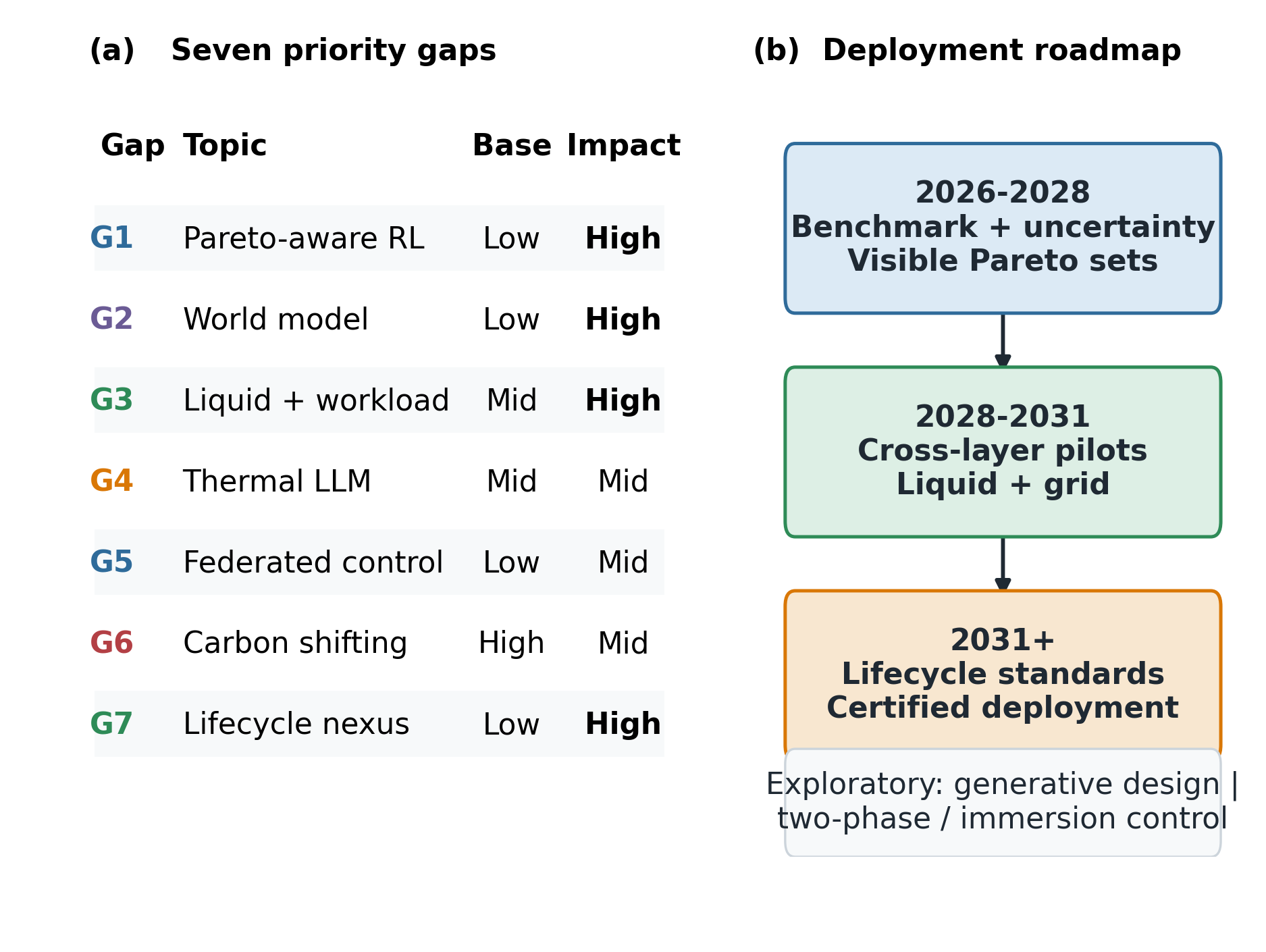
缺口按现有基础与潜在影响编码。高影响且低基础的格子,是最值得开新课题的地方;高基础的格子更需要标准,而不是又一篇仿真。 Gaps are coded by existing base and potential impact. High-impact, low-base cells are where new theses belong. High-base cells need standards more than they need another simulation.

G1

Pareto-aware RL

Base lowImpact high 让策略看见能量–水–碳–可靠–服务的前沿,而不是把权值藏进奖励。 Let policies see the energy–water–carbon–reliability–service front, instead of hiding weights inside a reward.

G2

World model

Base lowImpact high 可在规划中滚动的热–电世界模型,而不是只能回放的开环预测器。 A thermal–electrical world model that can be rolled for planning, not an open-loop predictor that can only replay.

G3

Liquid + workload

Base midImpact high 液环与负载放置的联合控制,是高密度机房接下来五年的主战场。 Joint control of the liquid loop and workload placement is the main battlefield of high-density halls for the next five years.

G4

Thermal LLM

Base midImpact mid 大模型可以做运行叙事、告警解释与规程检索;它们不是替代 MPC 的闭环控制器。 Large models can narrate operations, explain alarms and retrieve procedures. They are not a drop-in replacement for closed-loop MPC.

G5

Federated control

Base lowImpact mid 多租户与多园区不能假设数据集中。联邦控制要先解决安全与归属,再谈样本。 Multi-tenant and multi-campus settings cannot assume pooled data. Federated control must settle safety and attribution before it settles sample size.

G6

Carbon shifting

Base highImpact mid 基础已经不低。缺的是与热约束对齐的、可审计的碳账,而不是又一个地理迁移演示。 The base is already high. What is missing is an auditable carbon ledger aligned with thermal constraints, not another geo-migration demo.

G7

Lifecycle nexus

Base lowImpact high 把隐含碳、水足迹与设备寿命写进与运行控制相同的决策语言。 Write embodied carbon, water footprint and equipment life in the same decision language as operational control.

基准、不确定性、可见的帕累托集 Benchmarks, uncertainty, visible Pareto sets

没有共享扰动、没有违反统计、没有可复现目标,第三层方法无法被比较。这一阶段的产出应是测试床与报告规范,而不是更大的网络。 Without shared disturbances, violation statistics and reproducible objectives, Level-3 methods cannot be compared. The deliverable of this phase is testbeds and reporting norms, not a larger network.

跨层试点:液冷 + 电网 Cross-layer pilots: liquid + grid

把冷板回路、负载放置与碳信号放进同一个闭环试点。成功标准是约束违反与回退频率,而不是海报上的平均 PUE。 Put the cold-plate loop, placement and the carbon signal in one closed-loop pilot. The success criterion is constraint violations and fallback frequency, not mean PUE on a poster.

生命周期标准与认证部署 Lifecycle standards and certified deployment

探索性工作可以继续走向生成式设计与两相/浸没控制。主航道则应是可认证的部署:回退、监测、审计轨迹成为默认。 Exploratory work can continue toward generative design and two-phase or immersion control. The main channel should be certified deployment: fallback, monitoring and audit trails as defaults.

Figure 7. Research gaps and roadmap.
Plate VII
七个优先缺口与分阶段路线图。量子计算一类缺乏本语料支撑的外推,不出现在图中,也不出现在本教程里。 Seven priority gaps and a staged roadmap. Extrapolations that the corpus does not support — including unsourced quantum claims — do not appear on the plate, and they do not appear in this tutorial.

11 — Colophon

如何引用,以及还可以读什么 How to cite this, and what to read next

本站是综述的教学同伴,不是期刊版本本身。正式引用请使用手稿题名与作者。网页可用于课堂、组会与工业培训;涉及主张与文献编号,以经过核验的手稿为准。 This site is a teaching companion to the review, not the journal version. Formal citation should use the manuscript title and authors. The page is for classrooms, group meetings and industrial training. Claims and reference numbers follow the audited manuscript.

建议引用 Suggested citation

Li, F., Liu, H., Luo, H. & Shi, Y. From Black-Box Learning to Physics-Informed Control: Artificial Intelligence for Carbon-Neutral Data Center Thermal Management. Review manuscript TRCN-2026-0008 (2026).

通信:emlifei@bupt.edu.cn;shiyuqi@zju.edu.cn。作者单位:北京邮电大学经济管理学院;中国移动通信集团设计院有限公司。 Correspondence: emlifei@bupt.edu.cn; shiyuqi@zju.edu.cn. Affiliations: School of Economics and Management, BUPT; China Mobile Group Design Institute Co., Ltd.

READ FIRST

先读这五类 Five first readings

IEA 电力展望中的数据中心专章;ASHRAE 热环境指南;一篇诚实的用电估计方法论文;一篇现场或准生产控制论文;一篇冷板或芯片液冷实验。顺序比清单更重要。 The data-center chapter of the IEA electricity outlook; the ASHRAE thermal guideline; an honest methods paper on demand estimation; one field or near-production control paper; one cold-plate or direct-to-chip experiment. Order matters more than the list.

CLASSROOM

一学期怎么用 A one-term use

两次课走完第 1–4 章,一次课做图 5 的矩阵填空,一次课用图 6 审查一篇预印本,期末用 G1–G7 写研究计划。按 L 切换中英文。 Two sessions for chapters 1–4, one session filling the Figure 5 matrix, one session reviewing a preprint with Figure 6, a final proposal written against G1–G7. Press L to switch languages.